Showing posts with label currently reading. Show all posts

Sunday, August 29, 2010

Currently Reading


Remember when summer would roll around and the summer reading list for school would be released? I always looked forward to finding out what books were on the list and going to the library or book store, picking out the books, and coming home to pour over the pages all summer long.
I really miss the summer reading list. Being an adult is sometimes not as magical as being a child or adolescent. When I find that magic slipping away, I try to hold on to those simple things, like a reading list, that are able to inspire the levels of jubilation I experienced as a youth.
This summer seems to be consumed by work and moving. . . and little else.
I have, however, managed to create my own summer reading list, of sorts, and I'm currently working on what I think is one of the best books I have ever read.

The summer started with a selection made by Dana, for the e-book club. The Guernsey Literary and Potato Peel Pie Society by Mary Ann Shaffer and Annie Barrows, was a fun, easy read. I enjoyed starting the summer with a romance, set the the backdrop of post-World War II England. The love story is light and sweet, but the real jewel of the novel is the stories of the German occupation of the Guernsey Channel Islands. I had no prior knowledge of this event and reading about it in a fictional setting was, I think, a very interesting way to learn about it. I am a big fan of post-war fiction. War alters so much more than the landscape of a country, it is ever-present in the minds of the people who live through it. The novel was simple, but I love any book that reminds me of the weight of war.


I decided to stay on the British track for my next novel selection. David has been urging me for some months to read Last Orders by Graham Swift, so I obliged him. The story is about four men, charged with the duty of spreading the ashes of their friend. Each chapter is told from the perspective of one of the men, including the dead friend (prior to his death, of course). The stories are funny, disturbing, touching; they encompass the events of the men's lives and show the entanglement that results from a lifetime of friendship.


I am currently working on a novel that is very different from anything I have ever read. White Noise by Don DeLillo is, on the surface, a story about a typical blended family living in the 1980s. But beyond that, it is a post-modern examination of what makes a life. I think DeLillo suggests that what so many of our lives consist of is distraction and that the driving force of our distraction is an all-encompassing fear. Fear of what? DeLillo talks about one particular fear in the novel, bit I don't think it's as simple as categorizing our fears, I think the novel suggests that life itself is a fearsome thing. I am about half-way through the novel, and I am in love with DeLillo's writing. His phrasing of simple sentences is beautiful and the characters, while sometimes troubling, are so ridiculously human. I love literature that is able induce long periods of introspection and self-examination. White Noise is definitely one such book.


images via about.com, book rags.com and bookswim.com

Sunday, June 27, 2010

Currently Reading


Once again, I am behind on my Currently Reading blogs. I’m just going to stop saying “Once again”, because I’m ALWAYS behind. I think it’s becoming my trend to remember to blog after every 3 books. Or maybe the end of the third book is somehow corresponding with my 1 hour of time that I truly consider to be “free” per month. Hence the reason I have not blogged in . . . about a month.

Lots of things are happening, I just can’t seem to find the time or energy to talk about them.

And while it is possible that no one else will find my Currently Reading blogs interesting, I feel a strong desire to catalogue what I’ve been reading. I think this desire is due in part to the fact that besides working, reading is about all I do – and I barely have time for that these days.

So here goes, three book reviews condensed into one post:

The first book is really short – I think it’s only 80 pages or so. I guess it would be considered a novella. It’s My Mortal Enemy, by Willa Cather. Yes, I am getting closer and closer to finishing all of her works, which is both exciting and bittersweet. This story is told from the perspective of Nellie Birdseye, cousin to Myra Henshawe. Myra is married to Oswald Henshawe, and the narrative revolves around Nellie’s two main encounters with the couple, plus her memories of facts and fictions about the couple told to her by friends and relatives. Through Nellie’s encounters, Cather provides a glimpse into the marriage of Myra and Oswald, showing what their marriage looks like at different stages in their lives. Myra is the ward of a wealthy uncle. When Myra is young she decides, against the threat of disinheritance, to run away with Oswald to New York and start a life with him. Oswald is poor, but has promise and Myra is certain that with time, they will find themselves happy and living comfortably.

Nellie’s narrative begins when she meets Myra and Oswald on their visit home. The visit is short and Nellie is eager to see Myra again and learn more about her. Nellie has heard all of the stories about the couple and is eager to see what has come of their scandal. She travels with her aunt to New York, to pay a visit to Myra and Oswald. The couple seems to be living just as they had planned, and at first glance, their lives appear wonderful to Nellie. However, (and there’s always a “however, isn’t there) as Nellie becomes privy to a few revealing encounters, she soon realizes that all is not as it seems. They travel in an artistic circle, which appears glamorous on the surface, but they are struggling to maintain a life in the city – and Nellie perceives a strain between them which at first, she suspects must be about money. Cather uses the typical notion of financial strain to reveal a peculiarity in the couple. One would think that money is at the root of the strain, but it’s not. It’s something deeper, something that Nellie can’t seem to grasp. Cather ends Nellie’s visit in New York, and it is years later when Nellie next encounters the couple. Their circumstances are drastically altered and through the change, Nellie is able to see what is at the crux of their relationship, what is killing it from the inside out.

I’ll stop there. It’s a short story, but it is packed full of so many ideas about relationships and perceptions and how one’s own nature can be the very thing that sabotages any chance of happiness. Cather is the master of being able to convey so much with so few words!

The next novel is, again, by Cather. It is titled Shadows on the Rock and it is WONDERFUL! I know I probably say this about everything that she writes, but I think it may be my favorite, or at least tied with a couple of her other works for favorite. It is set in the 17th century and is about the founding of Quebec. It follows the lives of the early French settlers in the area. The main family in the novel is Euclide Auclair, the village apothecary and also a widower, and his daughter Cecile. The novel centers on their lives and the lives of the people in their little community. In many ways, this novel is a discourse on the practices of these early settlers - their religion, their means of survival, their connections to their home country, etc., but it is so much more! It is the story of the founding of a national identity. The thoughts and fears and passions of these first settlers are ingrained in the ongoing story of Canada. They are the “shadows on the rock” of the modern-day Quebec. My favorite character is Cecile’s little friend, Jacques. He is the son of a pathetic, shiftless woman, who gives him no real care, but he has such a strong desire to be good. He is drawn to good, clean, beautiful things - they seem to suggest salvation and safety to his young mind. His innocence and the care of his community is what seem to save him – such a lovely idea. The Catholic religion is very present in the novel. Cather’s depictions of what is good in religion and what is bad are always so truthful and insightful. It is a great story of beginnings and is, as always in a Cather novel, full of wonderful descriptions of both character and landscape.

The last book is My Year of Meats by Ruth Ozeki. I feel as though I should include a disclaimer with this review.

***DO NOT read this book if you have a strong affinity for meat*** Or maybe I should be saying ***DO read this book is you have a strong affinity for meat***

The book has very graphic depictions of cattle production and meat processing. It is disturbing, but very truthful.

I think the second disclaimer is the best, because despite the graphic nature of the novel, it is a wonderful book and I think it should be a mandatory read for every American citizen, or even for every single human being who consumes commercially produced meat! But the novel is not just about meat.

The protagonist of this novel is Jane, a Japanese-American and a documentarian by trade. She is approached by a Japanese television company, sponsored by beef industry executives, to produce a Japanese television show called My American Wife!. The show will document the daily lives of American housewives and will feature a segment in which each wife will prepare their own recipe for a beef dish. Jane is hesitant, but accepts the assignment and begins a year of travelling the U.S., visiting the different wives. Jane starts the year detached from the work she is doing, but as she learns more about each wife and also about the beef industry, she becomes entangled in the deception that pervades the industry. She becomes intent on exposing the truth about the beef industry, but even more, she desires to understand the truths in her own life and in the world around her. The novel also has a parallel story, which follows Akiko Ueno, the wife of Joichi, or “John, a representative of the beef industry execs who fund the tv show. Akiko is lives in Japan and is trapped in a terrifying, abusive marriage. Her husband assigns her the task of watching each episode of My American Wife!, hoping that some of the American sentiments about what makes a family will rub off on Akiko. His plan is successful, but not in the way he had hoped. What Akiko learns from Jane’s shows is the beauty of difference, and most importantly, that happiness is possible.

The novel is so beautifully written and yet it is also so hard to read. It is disturbing, enthralling, touching and best of all – it educates.

I cannot recommend this book enough. PLEASE, PLEASE, PLEASE read it.

The most important thing I learned from this book is awareness. We should all be aware of what we are sending out into the world. We should constantly be questioning our actions and our motives. We should always be thinking “Is this the best I can do? Is this product, or this idea, or this work the best I can give?” If it isn’t, then we should go back to the drafting table and work until we know that what we are sending out is the best. So many people are content with “good enough.” I don’t think I could stand to live in a world where everyone espouses that sentiment. I look around and I’m scared by the number of people who are settling for “good enough." But most of all, I’m scared by the overwhelming mass of people who prefer to stay comfortably blind to what is going on around them.

I love this book, because it ends on a very hopeful note. And I felt very hopeful when I contemplated the idea that novels like this can and are bringing about positive change. This book was actually published back in the 1998, so there are some improvements that have a happened since it came out, but we still have a very long way to go till we get where we need to be. We are the ones who shape this earth, and books like this are wonderful in helping us figure out how the world should look. It is definitely worth reading and is most definitely worth considering the ideas presented.

I think the next novel should be a fun, interesting read. I'm going to be reading Dana's book club selection, The Guernsey Literary and Potato Peel Pie Society!

images via amazon.com, longitudebooks.com and popculturebookreview.blogspot.com

Saturday, April 24, 2010

Currently Reading . . .

Wow, I am way, way behind on my “currently reading” posts. Three books behind, to be exact.

Since finishing My Ishmael, I have completed The Song of the Lark and The Bohemian Girl, both by Willa Cather. I am attempting to complete all of Cather’s works this year, as she is my favorite authoress. I don’t want to read them back to back, however, because I think that they might all bleed together, and I wouldn’t be able to distinctly recall each book. So I have determined to read a couple at a time, taking breaks to enjoy other novels, as well.

I will try to give a short review of the two books before moving on to the book I am currently in the middle of, W Somerset Maugham’s The Razor’s Edge.

The Song of the Lark is one of Cather’s earliest novels, and by far her longest. Many critics are very hard on Cather for The Song of the Lark, suggesting that the novel is too long; that Cather extends the ending of the novel well past the point of interest. I think the novel is wonderful, and I found myself engrossed in every inch of the story, even the ending chapter, which reviewers are most critical of. I think the last chapter only further cements ideas Cather presents in the novel, but in an unexpected way.

I was so intrigued with the main female protagonist, Thea Kronberg. I always find Cather’s females interesting, because they seem to never fully understand who they are and what they want, and I think to examine Cather’s female psyche is to examine Cather herself. Cather’s females are always driven by an ambition for self-improvement and to escape undesirable circumstances, whether they’re the circumstances of youth, family, or place. Once Cather’s females achieve their ambitions; they often find themselves missing something that they can never quite put into words. Most often their inability to see themselves clearly leads to a state of confusion concerning their own true desires that can only be resolved by some connection to “The Male”. Such is the case with Thea Kronberg, the daughter of a Colorado minister. Thea is a talented pianist who escapes the life of a common piano teacher by moving to Chicago, where she improves her musical talents and learns that her true gift lies in her voice. Thea becomes a famous opera singer, but at the height of her success, she is plagued by self-doubt and the feeling of never being able to achieve her true potential. In the end, Cather suggests that our feelings of success and failure are a menagerie of different points in life and our notions of how we are perceived, by ourselves, by characters from our childhood, adolescence and adulthood merge together to provide us with a sense of who we are and also where we are in connection to where we and others thought we would be. This novel is definitely worth reading. A notable section in the book is Thea’s summer spent amongst Native American cliff ruins in the west. Cather’s description of the ruins is beautiful. I could go on and on about all of the different things Cather brings up in this novel, as well as how this novel reveals so much about Cather’s complicated relationship with self and with place, but I won’t. Read it.

On to The Bohemian Girl. This work is actually a collection of Cather’s short stories, rather than a novel.

The Bohemian Girl is brilliant because in it, Cather links a single idea together seamlessly through stories that on the surface, differ so much from one another. The linking element in all of the stories is LIFE. Life in its brevity, in its beauty, in its terror, in its quietness. The task of all of the characters in these stories is to understand what version of life is most desirable. In one of her stories, a brief but brilliant life of self-satisfaction is gratifying above all others. In another story, a life based on a sense of place and belonging is most attractive. Cather makes no indication as to which versions of life are the “best”, but rather which will bring happiness or pain to certain types of people. I loved every story in this collection, even Paul’s Case which was rather disturbing.

That’s all I have to say about Cather for now.

Finally, I’ll relate a few thoughts about the novel I am currently reading, The Razor’s Edge.

I have never read a novel like it before. The novelty (ha!) I am referring to is not so much in the story, but in the construction. Maugham relates the affairs of a handful of characters through his interactions with them, meaning he is in the novel – his thoughts, his actions, his dialogues with the other characters, etc. I know that this is not a new construction, but it is one that I have never encountered and enjoyed as I do this novel. Once I overcame the notion of having the author as a character in the novel, I was able to focus on the story, which is wonderful. Maugham’s story is really about a young man, Larry Darrell and his interactions with Isabel, the girl he is in love with, her family and their circle of friends. The story spans almost half a century, covering post-WWI America, the Great Depression, and the years of recovery after the Depression all while following how these events affect the character’s relationships. Maugham only encounters the characters a handful of times, but through these interactions, and various items of news he receives concerning them, he reconstructs the rises and falls in their lives during this turbulent time in the world. I find this novel wildly appealing, because it explores how people who are about my age react to a very troubling time in American history. Some of the characters are faithful to the American dream and industry, both personal and economic, while Larry chooses a path of nomadic spiritual enlightenment, which seems to bring an inner peace. Through his clever observations, however, Maugham questions who is really happy – and the answer is so complicated! I am only half-way through, but I will say that after reading as much as I have, I feel a strong desire to leave my job and my place in the world and loaf about Europe concerning myself only with the pursuits of the spirit – as Larry does in the story. Be careful when reading this novel, you may wish to join me!

I don’t know about anyone else, but I find writing about what I read immensely helpful. Whenever I finish a book, I like to think about it for some time and writing my thoughts helps me sort out how I feel about the work. This blog has been a great way to journal what I read. My problem lies in remembering to write within a reasonable timeframe of finishing the book!

Hopefully, I can do a better a better job of cataloguing my reading in the future, and take one novel at a time to write about, but if I know me, I will probably continue writing extremely long posts anyways – one novel at a time or not!

p.s. I love cover art. I think these are particularly beautiful, especially the first and the last!

images via wilbrahamlibrary.org and amazon.com

Sunday, February 7, 2010

Currently Reading


I've already finished this book, but I'm way behind on posting, so this is to catch up.
I recently read My Ishmael, the "sequel" to Ishmael by Daniel Quinn.


I won't say too much about this novel, because it shares many of the same ideas as Ishmael. However, I will say that I enjoyed this novel much more than Ishmael. The narrator is Julie, a twelve-year-old girl searching for answers to the same questions Quinn presents in his first novel. Questions like "From whom can I learn about how people ought to live" and "How did the world end up in the state that it's currently in". She works out the beginnings of the answers to these questions through the same means Quinn introduced in Ishmael - through telepathic dialogues with Ishmael, the gorilla.
I found the dialogue and story in this novel much more engaging and interesting than Ishmael's conversations with Alan Lomax in the first novel. Julie is young, but very curious about the world. I like her as the narrator, because I feel that her youth allows her to look at the information Ishmael presents without prejudice, or pre-conceived opinions about his ideas. I also found the book to have a much more hopeful tone, but I think that may be due to the difference in narrators.
I liked this novel so much more than the first. I identified with Julie's sense of not knowing what to think, but having a strong sense of the need for change.
I'm not familiar with the subject matter of Quinn's third novel in the "series", "The Story of B", but maybe it will be even better than My Ishmael. We'll see . . .

Tuesday, December 8, 2009

Currently Reading . . .


The title of this post is a lie. I've actually finished reading this book and have moved on to it's sequel. As the picture shows, I've recently finished reading Ishmael by Daniel Quinn.
David and his mom have suggested this book to me multiple times, but for some reason I always put it on the back burner and chose something else. I am SO GLAD that I finally made time for this book.
The story is about a modern author who feels disillusioned with the current state of the world. He feels that he and the rest of the world are being lied to, but he doesn't know by whom or what the lie is. One day he sees an ad in the paper:

"Teacher seeks pupil, must have an earnest desire to save the world. Apply in person"

The narrator answers the ad only to find himself in a room with an overwhelmingly large gorilla named Ishmael. Even more surprising than being in a room with a gorilla is when the gorilla begins to communicate telepathically with the narrator.
I know this sounds kind of weird, but stay with me.
The narrator decides to look past the fact that he is able to communicate telepathically with Ishmael (which suggests that the reader must also suspend disbelief) and proceeds to have a series of discourses about the origins of our culture and about what Ishmael describes as the reason things are the way they are.
I'm really glad that I decided to finish this book before doing a post about it. About halfway through the book, once I had delved into Ishmael's explanations of what drives the two cultures described in the book, the Takers and the Leavers, I began to feel as though the world is spiraling out of control and that there is no way to fix it. I felt that the book was telling me that we've passed the point of being able to heal the planet and that this dismal fate is all due to our unwillingness to see ourselves as ONE of God's creations, a helper in taking care of the earth, rather than as the creation that has the right to destroy any other creature or environ, mistaking wants for needs. After finishing the book, I still agree with the second part of the above statement, but Ishmael's final lessons in the novel reveal a possible course to changing the way we view our role in the world. I ultimately left the novel feeling hopeful, yet concerned.
There is so much more to the book than solely what I've mentioned above.
The author provides a wonderful explanation of the agricultural revolution and our culture's movement away from the more sustainable methods of food gathering, such as the hunter/gatherer tradition, and many, many others. He also discusses the correlation between an increase in food production and unrestrained population growth. I had never really thought about those two together in the way that the author presents them.
This novel has changed my perspective on so many ideas. I don't want to misrepresent the ideas in this novel. The above thoughts are merely my interpretation of the author's words. I wanted to share my thoughts on this novel, because I feel that generating dialogs about ways to improve the life of the planet must be one of Quinn's goals in writing the novel.
I have started the sequel to Ishmael called My Ishmael and it is equally as thought provoking as it's mate. Once I get a little more into it, I'll try to remember to do another post.
I hope many, many people will read both books.

Sunday, July 5, 2009

Currently Reading

I just realized that I haven't done a "Currently Reading" post in a long time.
I've been finishing up a few books that I had previously started, but never finished.
Now I'm on to a book that I have wanted to read for some time.

I'm currently reading For Whom the Bell Tolls by Ernest Hemingway.
I haven't gotten very far into it, but i really love what I have read. Hemingway is the master of conveying wonderful imagery through minimal language. The main character, Robert Jordan is currently en route to blow up a bridge in the mountains of Spain. I love all of his encounters with the residents of the mountains. I was interested to learn that the novel takes place during the Spanish Civil War, a war I'm not at all familiar with. Most of the modern literature I've read deals with the two World Wars, so this should be a nice change of pace.

I have to admit, my primary desire to read this novel arises from my interest in the title. I love John Donne's Meditation 17. Hemingway snagged his title from the famous section of this Meditation.
It's beautiful:

No man is an Iland, intire of it selfe; every man
is a peece of the Continent, a part of the maine; if
Clod bee washed away by the Sea, Europe is the lesse,
as well as if a Promontorie were, as well as if a Mannor
of thy friends or of thine owne were; any mans death
diminishes me, because I am involved in Mankinde; And
therefore never send to know for whom the bell tolls;
It tolls for thee. -John Donne


I wish we all thought about these words a little bit more.


(original text)
(image via Bookpoi)

Thursday, April 9, 2009

Currently Reading


Thanks to my lovely friend Stephanie, I am currently reading this wonderful book. The Glass Castle is by Jeannette Walls and is a memoir of her crazy life growing up. I find her stories so intriguing, because growing up with a parent or parents who suffer from mental illness is such a singular thing. Many of her stories are beautiful and very often funny, but as Walls tells them, you sense the pain of remembrance.
I really love the story early on, when they're driving through the desert in their car, and they drive over railroad tracks. The car is so old and rickety, the door flies open and Walls rolls out. She comes to and realizes that her parents don't know that she has fallen out. She has to wait several minutes, when finally she sees the car coming back for her. The story is funny, but you also understand the state of their family in this scene.
I wasn't sure if I would love this book, like I love David Sedaris' tales, but Walls' stories are engaging, meaningful and like Sedaris, they bring to the surface my memories of my family and the idea that all lives are a mixture of beauty and pain.
Thanks Steph. I'm really enjoying it.

Friday, March 6, 2009

Currently Reading


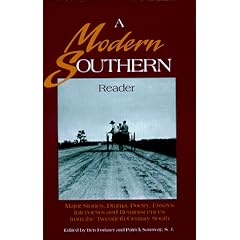
So I originally bought this book for one of my favorite college classes. I'm sure I've mentioned Dr. McAlexander's Southern Literature course before. I won't go into how much I love him again, but I will say that I really love this book! It is titled A Modern Southern Reader and it's an anthology of short stories, poetry and essays written by modern Southern authors. We read several selections while I was taking the class, but I haven't picked it up in a while. This time around I've read "Children on Their Birthdays" by Truman Capote and "The Jilting of Granny Weatherall" by Katherine Anne Porter. They are wonderful. Both authors are able to create memorable characters that embody the idea of the modern South, while still conjuring iconic southern imagery. The poetry is also really well done. I like John Crowe Ransom, in particular. Great read with lots to think about!

Tuesday, February 3, 2009

Currently Reading


This is one of the best books I have ever read! I cannot wait to finish it. The images in the novel are heartbreakingly beautiful and unforgettable. I can't believe I waited so long to read it! David kept telling me how wonderful it is, and I had it on a "to read" list, but for some reason I never picked it up.
The story follows the main character Pi Patel. Yann Martel gives glimpses of Pi's life, including his experience of being stranded in a life boat with a hyena, an orangutan, a zebra and a Bengal tiger. I feel a sense of familiarity when I read this novel. The images and setting are foreign, but the emotions are so familiar. Happiness is Martel's sloth and the Pondicherry zoo. If you have not read this book-read it!

Friday, January 16, 2009

Currently Reading


Rarely do I laugh out loud when reading, but I can count on doing so any time I pick up one of his books. He reveals all of the deeply mortifying things about family life that we all experience in some form, but does so with more humor than most of us are capable of. I love everything that David Sedaris has written. He is my go to for a fun read! My favorite so far is the Chapter 2, "Let It Snow".

Friday, December 5, 2008

Currently Reading


I finished Middlemarch a few months ago, and a day or so ago I remembered that I have completely forgotten to keep up with what I'm currently reading. Since Middlemarch, I have read the Twilight series for the second time (yes, I know I'm obsessed) and I've picked up three different books, but I didn't finish any of them - I just couldn't get into them. Finally, after searching through our library for the right book, I came across one that interested me.
The book is The Last Gentleman by Walker Percy. I read the book for my Southern Literature class (which was one of the best classes I took in my college career- Dr. McAlexander is the BEST!). I realized that I didn't remember much about this book besides the basics. The book was the last book we were assigned to read before the final, so I'm sure I probably rushed through it and absorbed very little.
I have been really interested in all things New York since our trip in October and I remembered that the novel is set in New York City in the late 1960s. The novel is a post-modern tale of a young, southern man living in the city. I'm only a little ways in, but I'm starting to remember some of the reasons why the book is worth a second read. Instead of writing long-winded paragraphs, naming what I like and dislike about the book, I will give the four main reasons I feel the book is wonderful.
1. The main character in the book is in his 20s, and I find his perspective on just about everything intriguing.
2. All of Percy's characters have little idiosyncrasies that make them fun to read about.
3. Percy touches on all of the important issues-love, religion, identity, etc.-in an entertaining, refreshing way. The novel is not self-important.
3. Percy does a great job creating an atmosphere in which experience and thought mean nothing and everything at the same time.

Friday, August 29, 2008

Currently Reading

A few weekends ago, David was at the computer and I was standing beside him when I got the urge to pull all of our books out of our four bookcases and organize them (thanks to David, I have become an organizing freak-of-nature). So I did, and I organized them according to genre and time period. Organizing the books was nice, because it made them so much easier to locate and it satisfied the OCD in me. Wednesday, I was standing around again when I decided to count all of the books I've read in our book collection. I realized that there is an entire bookcase full of our books that I have not read! Because of this realization, I have decided that I am not going to buy another book until I have read every book that we own. We have lots of good books, so I am very excited about the next several months of reading I have ahead of me. I've decided to use my blog to keep track of the books I'm reading.
So . . .

I'm currently reading: Middlemarch by George Eliot


Middlemarch was originally published between the years of 1871-1872 as a serial before being published in one volume in 1874. It is subtitled A Study of Provincial Life. The story is about a group of characters living in the Midlands of England in the early 1830s.
I really love this book! I love how you get to see into the lives of all of the characters-you get to hear their thoughts on everything: love, religion, politics, family, economy-and you get to see how all of their lives are connected by the choices that each one of the characters make. The female characters are my favorite part of the book. They are so interesting because their choices (both big and small) cause me to experience sympathy, rage, and complete understanding-all at the same time! Eliot is great at developing all of her characters in a way that makes you very interested to see what happens to them.
It is a long book (almost 800 pages), but the serialization makes it really easy to read. I also really love how Eliot heads each section in the book with quotations. Some of them are in foreign languages, but the guide in the back of the book translates them and it's fun to try to figure out how each quote is going to relate to its section.
David's brother recommended this book to me, and I'm very grateful that he did, because it has become one of my favorites! Hopefully, this part of my blog will serve a similar purpose. I can keep track of my reading and recommend books, simultaneously!
I expect to be finished with Middlemarch by the end of next week, so look for a new post soon!